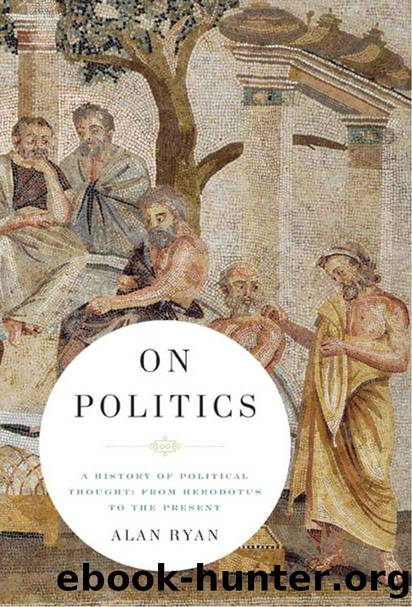
On Politics: A History of Political Thought: From Herodotus to the Present by Alan Ryan
Author:Alan Ryan [Ryan, Alan]
Language: eng
Format: azw3
Publisher: Norton
Published: 2012-10-14T16:00:00+00:00
Rousseauian Liberty
So we must ask what Rousseau meant by freedom. The argument of the Social Contract is that it must be possible to combine freedom and law; contra Hobbes and others, he insisted that if we gave away our freedom, we had given away our humanity. He argued that âobedience to a law we prescribe to ourselves is freedom,â but left it less than clear how this prescribing happens, and how many kinds of freedom there are. On the face of it, the view he should have held would have distinguished three sorts of freedom. All would meet the requirement that we are not told what to do by other people, and that we are not subject to other peopleâs arbitrary whims. They also, more contentiously, satisfy the requirement that we are not governed by our own arbitrary whims, and are governed reasonably, if not by Reason, or by reasons if not always by our own reason. Thus natural man is free and happy, and enjoys natural freedom. He is free from domination. He does not prescribe laws to himself, because the idea of prescribing is beyond him. He follows the laws that nature prescribes to himâwhich are such as he would prescribe for a creature like himself, if he had the conceptual apparatus to do so. Because nature prompts him to the pursuit of harmless good and away from self-destruction, he is not governed by whim, even if he enjoys harmless play; in short, he acts reasonably without being rational and follows the dictates of the reason embodied in nature, though he is not conscious of it. His obedience to appetite is not slavery, for he has in himself nothing to oppose to appetite; only the person for whom acting on principle is a possibility can be a slave to his appetites.
The man whose character is healthy, and whose moral attachments are correct, enjoys moral freedom and may with luck enjoy a lot of natural freedom if the state is unoppressive. He truly prescribes rules to himself, the rules of a rational morality. His will is governed by reason, not whim, and to make that freedom secure he requiresâhere Rousseauâs liking for Stoic ideas appearsâthe ability to stand up to public opinion, to go his own way rather than behave badly in popularly approved ways, and so on. He need not be a philosopher; it is better for him if he is not. The heart is often a better guide to the dictates of duty than the head, even though a philosopher of sound views can explain why the heart prompts him as it does. Finally, the man who finds himself in a lawful republic can enjoy a third sort of freedomâcivic freedomâas well as moral freedom and whatever natural freedom local conditions allow. Rousseau appears to have two kinds of civic freedom in mind, one Montesquieuan, the other more nearly Machiavellian; the first says that a state violates my freedom if it forces me to do what I
Download
This site does not store any files on its server. We only index and link to content provided by other sites. Please contact the content providers to delete copyright contents if any and email us, we'll remove relevant links or contents immediately.
Personalized inhaled bacteriophage therapy for treatment of multidrug-resistant Pseudomonas aeruginosa in cystic fibrosis by unknow(214775)
CONSORT 2025 statement: updated guideline for reporting randomized trials by unknow(102521)
Critical evaluation of the ProfiLER-02 study design and outcomes by Vivek Subbiah & Razelle Kurzrock(102046)
Cardiac gene therapy makes a comeback by Oliver J. Müller & Susanne Hille & Anca Kliesow Remes(101838)
Whisky: Malt Whiskies of Scotland (Collins Little Books) by dominic roskrow(74619)
Unveiling the design rules for tunable emission in graphene quantum dots: A high-throughput TDDFT and machine learning perspective by Şener Özönder & Mustafa Coşkun Özdemir & Caner Ünlü(51002)
A yeast-based oral therapeutic delivers immune checkpoint inhibitors to reduce intestinal tumor burden by unknow(40374)
Covalent hitchhikers guide proteins to the nucleus by Alexander F. Russell & Madeline F. Currie & Champak Chatterjee(40296)
Meet the Authors: Christopher R. Mansfield and Emily R. Derbyshire by Christopher R. Mansfield & Emily R. Derbyshire(40208)
Alkaline-earth metals promote propane dehydrogenation with carbon dioxide through geometric effects: Altering the reaction pathway by unknow(32814)
Induced iron vacancies boosting FeOOH loaded on sustainable Fenton-like collagen fiber membrane for efficient removal of emerging contaminants by unknow(32611)
Efficient electric-field-assisted photochemical conversion of methane to n-propanol exclusively over penetrated TiO2Ti hollow fibers by Guanghui Feng(32530)
Bi2SiO5 nanosheets as piezo-photocatalyst for efficient degradation of 2,4-Dichlorophenol by Hangyu Shi & Yifu Li & Lishan Zhang & Guoguan Liu & Qian Zhang & Xuan Ru & Shan Zhong(32468)
A novel NDIPTA organic heterojunction photocatalyst with built-in electric field for efficient hydrogen production by Jiahui Yang & Baojun Ma & Yongfa Zhu(32443)
Enhanced conversion of methane to liquid-phase oxygenates via hollow ferrite nanotube@horseradish peroxidase based photoenzymatic catalysis by Jun Duan & Shiying Fan & Xinyong Li & Shaomin Liu(32405)
Ordered macroporous superstructure of defective carbon adorned with tiny cobalt sulfide for selective electrocatalytic hydrogenation of cinnamaldehyde by Xiao-Shi Yuan & Sheng-Hua Zhou & San-Mei Wang & Wenbo Wei & Xiaofang Li & Xin-Tao Wu & Qi-Long Zhu(32335)
What's Done in Darkness by Kayla Perrin(27260)
Topological analysis of non-conjugated ethylene oxide cored dendrimers decorated with tetraphenylethylene: Insights from degree-based descriptors using the polynomial approach by A Theertha Nair & D Antony Xavier & Annmaria Baby & S Akhila(26631)
Investigation of mechanical and self-healing properties of hydroxyl-terminated polybutadiene functionalized with 2-ureido-4-pyrimidinone by Mohsen Kazazi & Mehran Hayaty & Ali Mousaviazar(26555)
